
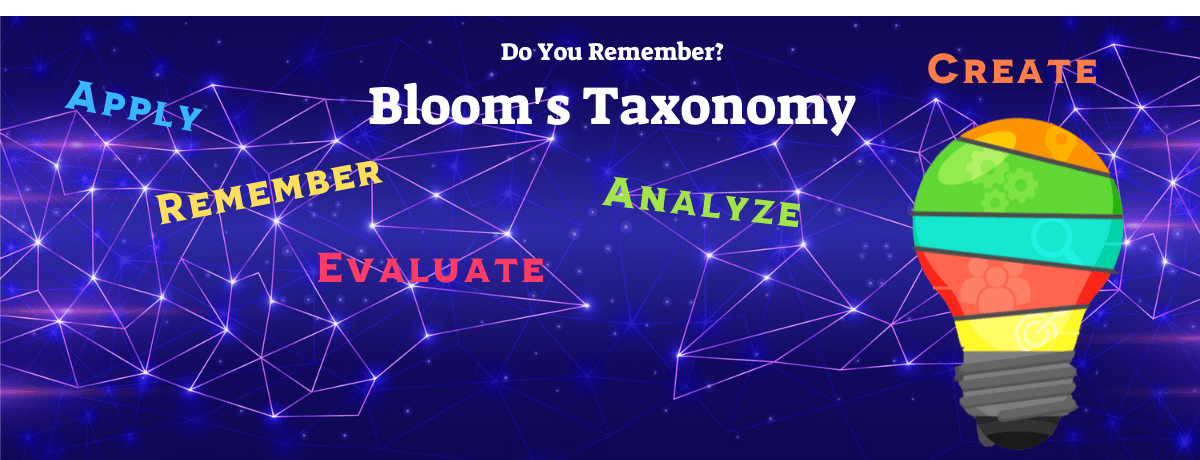
Bloom’s Taxonomy is a widely known educational framework used by teachers and leaders at all age groups. Let’s walk through the 5 basic stages of the taxonomy. Created by Educational Psychologist Benjamin Bloom in 1956, Bloom’s taxonomy provides an ordering of cognitive skills and is a practical tool that can be used when planning lessons that seek to maximize student learning.
ThinkFives knows that the classic taxonomy is 6 pyramid levels but for your reading pleasure we have combined the first 2 levels — remember and understand — because we know you really want to climb the learning pyramid quickly.


Remember and Understand
At the first level in Bloom’s taxonomy, students can remember facts/events and memorize items like multiplication tables. But learning may be limited as a student can recall facts without fully grasping the meaning or concept behind it. Understanding is the second level and a higher level than remembering. A student can now discuss a problem or idea. This is an important step in the learning process and necessary before they can apply what they have learned.
Think words like: Define, Describe, List, Classify, Explain, Summarize


Apply
When students apply an understanding, they can internalize the concept and implement it in a novel situation. For example, they can use a math formula they have learned to calculate a family budget in the real world or apply a legal ruling to a specific case.
Think words like: Calculate, Demonstrate, Interpret, Show, Solve. Suggest


Analyze
At the analysis level, students can go beyond knowledge and analyze a problem. They can draw connections between ideas, utilize critical thinking and break down arguments. This includes logical deduction, finding fallacies and classifying new data.
Think words like: Appraise, Compare, Contrast, Distinguish, Explore, Infer


Evaluate
At this higher level, students can make an educated judgment about the value of the material they’ve just learned and can evaluate the difference between fact and opinions or inferences —and we hope Fake News. Critiques, recommendations, and reports are some of the classroom projects that make up this level.
Think words like: Assess, Critique, Defend, Evaluate, Judge, Justify


Create
When a student can produce an original artwork, design, or concept from scratch and are using previous information to create, they have reached the highest level in Bloom’s taxonomy. This process is the most difficult mental function in the new taxonomy. Student portfolios and project-based learning are examples of classrooms that are creating.
Think words like: Construct, Create, Devise, Generate, Organize, Plan
Source: https://technologyforlearners.com/applying-blooms-taxonomy-to-the-classroom
What are good examples of lessons that focus on Evaluate or Create? Comment below.
Always nice to get a refresher on the Bloom’s Taxanomy
I feel like a great experience where I evaluate a piece of material is when I just finished watching a How-To Video on YouTube. For example, I was watching a video on tips/tricks on working productively, and it says that we should continue pushing through. I believe that taking breaks are very critical to help charge your brain and have a reset mode so that you can have a clearer mind when coming back to work on a task.
📖💡
My favorite level is to create, but sometimes it’s hard to find time to dive deep and give time for that while staying on pace with the curriculum.